

Is your school hallway just a passage from one class to another? A blank canvas of lockers and bulletin boards, waiting for a story to be told? You’re in the right place to give it a purpose.
Veterans Day decorations in a school shouldn’t just be red, white, and blue crafts; they should be the heart of a lesson, a backdrop for honor, remembrance, and education.
This is your creative playbook for transforming your school’s spaces into a tribute that’s not only beautiful and respectful but feels deeply, personally meaningful to your students and community.
We’ll explore impactful displays, decode the secrets of patriotic style, and walk through the practical steps to create a school-wide atmosphere of gratitude.
By the end, you’ll see your walls not as a surface to be covered, but as an opportunity to honor our heroes.
Before You Begin: Dreaming Up Your School’s Tribute
The most meaningful displays start with a little bit of purpose-finding, not just a trip to the supply closet.
Before you unroll a single sheet of butcher paper, let’s lay the groundwork for a design with a mission. What do you want your students to learn? What do you want them to feel? The goal is creating an atmosphere of gratitude, not just glitter.
The Secrets of Style: Simple Rules for a Meaningful Display
Design theory sounds intimidating, but it’s really just about what makes a space feel right. Here are a few simple secrets for a respectful and beautiful display:
Layers of Meaning: A great school display has depth, both visually and educationally. Think in layers: a bold background, a central visual element (like a flag), and then the most important layer the students’ own words, handprints, or contributions.
Play with Scale: Create a powerful visual journey through your school.
- Go Big in Common Areas: Use a large-scale mural or a “Hall of Heroes” in your main entryway or cafeteria to make a powerful first impression.
- Go Personal in Classrooms: Use classroom doors and bulletin boards for more detailed, specific tributes that students can connect with daily.
The Patriotic Palette: This is a foolproof recipe for a cohesive and classic color scheme:
- 60% is your base color: Blue. It’s calming, stately, and provides a strong foundation. Use it for background paper or tablecloths.
- 30% is your secondary color: White. It provides clean, open space for text and student work to stand out.
- 10% is your accent: Red. Use it for powerful pops of color a border, a student’s handprint, the stripes of a flag.
Focus on the “Why”: This is the most important rule. Every decoration should have a purpose. A display of stars is nice; a display of stars, each with the name of a veteran from your community, is meaningful. Let every decoration be a conversation starter and a lesson in itself.
What’s the Real Effort? A No-Fuss Project Breakdown
| The Approach | Estimated Cost | What Your Money Buys | The Little Extras (Don’t Skip These!) |
| The Classroom Corner | $15 – $50 | • Construction paper, markers • String and clothespins • Printable templates | • A good stapler • Student participation! • Glue sticks and scissors |
| The Hallway Takeover | $50 – $150 | • Rolls of butcher paper • Tempera paint and brushes • Photo printing services | • Parent volunteers<br>• Coordination between classes • A projector for tracing |
| The School-Wide Tribute | $150 – $300+ | • A large banner or vinyl lettering • Materials for a semi-permanent display • Outreach to local veterans groups | • School administration approval • A designated project lead • A plan for a school assembly |
The Design Menu: Finding Your Signature Tribute
Here are the ingredients for your perfect school-wide Veterans Day display. Each one is a simple idea designed for maximum educational and emotional impact.
1. The Hall of Heroes

- Best For: Creating a personal and powerful connection between students and veterans.
- The Idea: Ask students, faculty, and staff to bring in photos of family members who are veterans. Create a beautiful display on a main wall with the photos, names, military branches, and their relationship to the student/staff member.
- Key Consideration: Privacy is crucial. Ensure you have permission to display each photo and story.
- Pro-Tip: Scan all the photos and print them uniformly to create a cohesive look and protect the original pictures.
- Styling Cue: Mount the photos on a deep blue background with a simple, respectful title like “Our Community of Heroes.”
2. The Gratitude Graffiti Wall

- Best For: An interactive display that allows every student to participate.
- The Idea: Cover a large bulletin board or wall with white butcher paper. In the center, write “Thank You, Veterans!” in large letters. Leave out red and blue markers and encourage students to write messages of thanks, draw pictures, or write the names of veterans they know.
- Key Consideration: This can get messy. Have a teacher or volunteer monitor the wall to ensure messages are appropriate.
- Pro-Tip: Use prompts to help younger students, such as “I am thankful for veterans because…” or “A hero is someone who…”
- Styling Cue: Create a bold border of red, white, and blue handprints made by the youngest students in the school.
3. The Handprint American Flag

- Best For: A collaborative, all-school project that creates a stunning visual centerpiece.
- The Idea: Use a large piece of white paper as your base. Have students make red handprints for the stripes and blue handprints for the canton (the corner square).
- Key Consideration: This requires logistical planning. Set up a station and have classes rotate through to add their handprints.
- Pro-Tip: Use white paper star stickers for the stars on the blue field, or have older students paint them on after the handprints are dry.
- Styling Cue: Hang the finished flag in your school’s main lobby or cafeteria where it can be seen by everyone.
4. The Stars of Service

- Best For: A simple craft that allows each student to honor a specific veteran.
- The Idea: Each student decorates a paper star. On the star, they write the name of a veteran they know, their branch of service, and a single word that describes them (e.g., “Brave,” “Strong,” “Dedicated”).
- Key Consideration: Provide a list of positive character traits to help students who may have trouble thinking of a word.
- Pro-Tip: Laminate the stars before hanging them. This makes them more durable and gives them a professional finish.
- Styling Cue: Hang the stars from the ceiling in your main hallway or library with fishing line so they appear to float, creating an immersive “sky of stars.”
5. The Classroom Door Tributes

- Best For: Encouraging individual classroom participation and a little friendly competition.
- The Idea: Assign each classroom or grade level one of the branches of the military (Army, Navy, Air Force, Marines, Coast Guard, Space Force). Have them decorate their classroom door to honor that specific branch, including its mission, seal, and colors.
- Key Consideration: Provide teachers with a simple fact sheet about each branch to ensure accuracy.
- Pro-Tip: This is a great cross-curricular activity, blending art with social studies and research.
- Styling Cue: A walk down the hallway becomes an educational tour of the United States Armed Forces.
6. The “What a Veteran Means to Me” Quilt

- Best For: Combining writing, art, and personal reflection.
- The Idea: Give each student a square of paper. On it, they can write a short sentence or draw a picture that answers the prompt, “What does a veteran mean to me?” Assemble all the squares together on a bulletin board to look like a paper quilt.
- Key Consideration: The variety of responses from different age groups will be beautiful and poignant.
- Pro-Tip: Use a red, white, and blue paper border around each square to create a unified look for your “quilt.”
- Styling Cue: Title the bulletin board “Woven Together by Gratitude.”
7. The “Thank You” Chain

- Best For: A simple, symbolic craft for younger students that shows collective effort.
- The Idea: Have students write or draw messages of thanks on strips of red, white, and blue paper. Link the strips together to create a long paper chain.
- Key Consideration: The power of this decoration is in its length. The longer the chain, the more impactful it is.
- Pro-Tip: Challenge the school to make the chain long enough to stretch the entire length of the main hallway.
- Styling Cue: Drape the chain across doorways, windows, and down the center of the cafeteria.
8. The Window Silhouettes

- Best For: Creating a respectful and visually striking display on outward-facing windows.
- The Idea: Cut out silhouettes of soldiers, the flag raising at Iwo Jima, or military vehicles from black paper. Tape them to the inside of windows.
- Key Consideration: The effect is most powerful when viewed from the outside, as the light from inside will illuminate the scene at dusk.
- Pro-Tip: Use a projector to trace complex silhouettes onto black butcher paper for perfect, large-scale cutouts.
- Styling Cue: For a different effect, use blue painter’s tape to create a “stained glass” flag look on your windows.
9. The Flags of Our Branches

- Best For: An educational display that honors the different roles within the military.
- The Idea: On a long bulletin board, display the official flag of each branch of the military. Under each flag, include a brief, student-friendly description of what that branch does.
- Key Consideration: Ensure you use the correct, current flags.
- Pro-Tip: Print the descriptions in a large, easy-to-read font. This is a perfect decoration for a library or a main hallway where students often wait in line.
- Styling Cue: Mount the flags on a clean white background to make their unique colors and seals stand out.
10. The Dog Tag Display of Gratitude
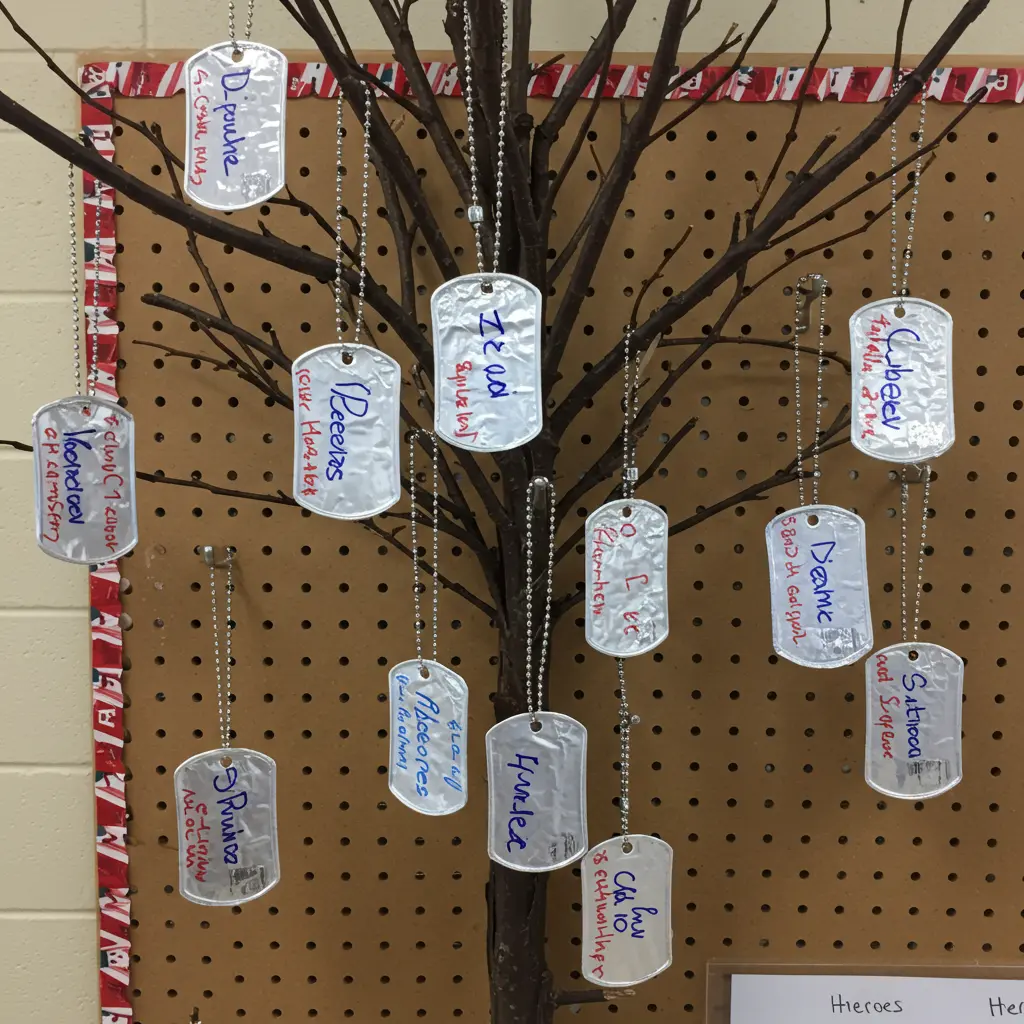
- Best For: A unique visual that represents individual service members.
- The Idea: Have students create “dog tags” from cardboard rectangles covered in aluminum foil. On each tag, they can write the name of a veteran or a message of thanks.
- Key Consideration: The “clinking” sound these make when hung together adds an interesting sensory element.
- Pro-Tip: Punch a hole in each tag and hang them with ball chain (available at craft stores) for an authentic look.
- Styling Cue: Hang the dog tags from the branches of a “Heroes Tree” or on a pegboard in a grid pattern.
11. The Letters to Veterans Mailbox

- Best For: A functional decoration that encourages community outreach.
- The Idea: Decorate a large cardboard box to look like a mailbox. Throughout the week, have students write letters and cards of thanks to veterans.
- Key Consideration: Coordinate with a local veterans’ organization (like a VFW post or a VA hospital) to deliver the letters.
- Pro-Tip: Provide templates for younger students to help them structure their letters.
- Styling Cue: Place the mailbox in a central location, like the school office or library, with a sign that clearly explains its purpose.
12. The Patriotic Paper Windsocks

- Best For: A fun, kinetic craft for younger students that adds color and movement to hallways.
- The Idea: Use blue construction paper for the main cylinder. Have students add red and white paper streamers for the tails and white paper stars for decoration.
- Key Consideration: They need to be hung from the ceiling where they can catch the breeze from open doors and vents.
- Pro-Tip: A simple and fast way to make stars is with a star-shaped hole punch.
- Styling Cue: Hang them at varying heights to create a more dynamic and visually interesting display.
13. The Freedom is Not Free Wall

- Best For: Older students, to encourage deeper reflection on the meaning of service.
- The Idea: Create a display centered around the phrase “Freedom is Not Free.” Ask students to write or illustrate what that phrase means to them on paper cutouts shaped like states or stars.
- Key Consideration: This can be a very powerful display. Frame it with respectful imagery.
- Pro-Tip: Include quotes from veterans or historical figures about service and sacrifice.
- Styling Cue: Use a stark black background to make the students’ reflections and the central message pop.
14. The “Our Heroes” Tree

- Best For: An interactive display that can grow over the course of a week.
- The Idea: Create a large, bare tree shape on a wall or bulletin board from brown paper. Provide leaf-shaped cutouts in red and white. Students can write a veteran’s name on a leaf and add it to the tree.
- Key Consideration: This is a beautiful visual representation of the school’s collective gratitude.
- Pro-Tip: Place a small basket of the blank “leaves” and markers next to the display so it’s easy for students and staff to add to it.
- Styling Cue: Title the display “Our Family Tree of Heroes.”
15. The Poppy Field of Remembrance

- Best For: A respectful nod to the symbol of remembrance and sacrifice.
- The Idea: Have students craft simple poppies from red paper or cupcake liners with black centers. “Plant” them on a bulletin board to create a field.
- Key Consideration: While poppies are most associated with Memorial Day, they are a powerful symbol of sacrifice. Use this as a teaching moment to explain the difference between the two holidays.
- Pro-Tip: Create a sign that explains the symbolism of the poppy, referencing the poem “In Flanders Fields.”
- Styling Cue: Place the poppies on a green background with a blue paper “sky” for a beautiful and poignant scene.
16. The Library Book Display

- Best For: Integrating the tribute with literacy and curriculum.
- The Idea: Ask the school librarian to curate a special display of age-appropriate books about veterans, military history, and patriotism.
- Key Consideration: This is one of the easiest and most effective ways to encourage learning.
- Pro-Tip: Decorate the display area with small American flags and student-made “book reviews” of their favorite patriotic stories.
- Styling Cue: Frame the display with a banner that reads “Read About a Hero.”
17. The American Eagle Mural

- Best For: An art-focused, collaborative project that creates a powerful symbol of the nation.
- The Idea: Have the art teacher lead a project to create a large American eagle mural.
- Key Consideration: This can be made from a variety of materials.
- Pro-Tip: For a stunning 3D effect, create the eagle’s feathers from individual paper cutouts that students have written messages on.
- Styling Cue: Place the eagle on a background of a waving American flag and have it hold a banner in its beak that says “Thank You, Veterans.”
Conclusion: Your School’s Lasting Lesson
And just like that, you’re no longer just decorating a school you’re creating an immersive lesson in gratitude. You have the ideas, the inspiration, and the know-how to create a tribute that is beautiful, educational, and a true honor to those who have served.
This isn’t just about making the hallways look festive; it’s about planting seeds of respect and understanding in the hearts of your students.
It all starts with a single choice. Pick an idea that resonated with your school’s spirit, and let the tribute begin. You’ve got this.
